
With SAP Business One ERP, you are getting an integrated software system and management solution with financial and accounting capabilities. We are based in Kenya and able to provide local support with a strong certified team that has domain knowledge and strong experience in deploy solutions for Kenyan companies taking into consideration Kenyan statutory requirements and other obligations.
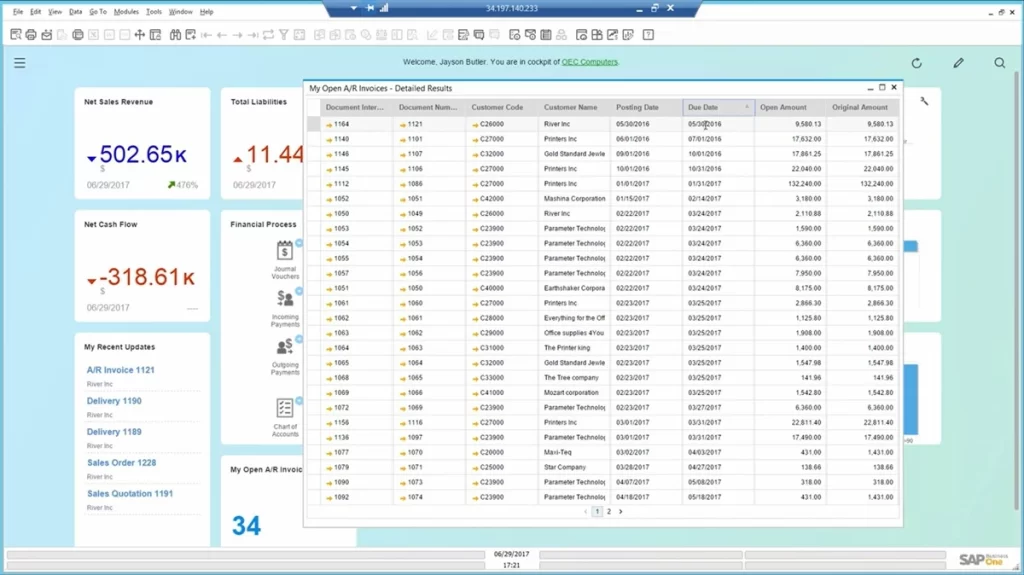
SAP Business One provides a complete set of tools to help manage and streamline your financial operation. It automates everyday financial and accounting tasks such as maintaining ledger and journal entries, supporting tax calculations, and enabling multicurrency transactions. You can conduct all your banking activities – including processing bank statements and payments, as well as reconciling accounts. You can also manage cash flow, track budgets, and compare actuals versus plans to see where your business stands at a moment’s notice. By integrating your financial and accounting operation in real time with other business processes, such as purchasing and sales, you can speed transactions and improve visibility into cash flow.

Improve margins, reduce errors, and drive more profitable decision-making

Automatically handle all key accounting processes, such as journal entries, accounts receivable, and accounts payable.

Accurately manage cash flow, track fixed assets, control budgets, and monitor project costs.

Management of fixed assets, the virtual fixed asset function frees you from repetitive manual data entry.

Quickly process reconciliations, bank statements, and payments by various methods including checks, cash, and bank transfers.

Create standard or customized reports from real-time data for business planning and audit reviews.
SAP Business One is the best selling ERP software system in Kenya and trusted by over 85,000 customers and one million users. The ERP system provides clear visibility into your entire business and complete control over every aspect of your operations.
Explore ERP System OverviewOutgrown your existing system, find out why you should upgrade to an ERP System
Explore ERP System vs Accounting SoftwareWith support for multiple currencies, budgeting, and bank reconciliation, SAP Business One delivers financial and accounting management functionality that enables your enterprise to be more efficient and more productive.

Create and manage charts of accounts for any country using locally compliant templates, which you can adapt to fit your unique business needs. Define individual charts of up to 10 segments (or levels), if needed, to support your businesses processes and reporting requirements. You can create segmented charts of accounts that represent your departments, divisions, regions, branches, and so forth.
Benefit from functionality that automatically posts journal entries from the sales, purchasing, and banking areas and also either manually or automatically creates new journal entries. You can search for existing entries and automatically allocate each transaction to a project or a profit center.
Save multiple manual journal entries to a batch to review them before processing. This allows you to verify and correct postings if necessary before they are entered into the general ledger.
The patented tax engine in SAP Business One has been designed to address a variety of complex tax requirements while maintaining a user-friendly interface that can be maintained by your company’s tax professional. The tax engine has a high degree of configurability, allowing it to address known tax requirements in addition to future tax modifications.
Define general ledger accounting templates to save time and help avoid mistakes during the manual posting of journal entries.
Define your own postings for regular execution in accounting and specify a frequency for each recurring posting. With recurring postings, the application automatically reminds you to post your transactions.
Reverse month end accruals automatically. By default, reversal of specified postings occurs on the first day of the next month, but SAP Business One allows users to specify a different reversing date for each posting, if desired.
Periodically evaluate your open items in foreign currencies to identify differences and choose the appropriate correction transaction.
Track all banking processes, from cash receipts and check writing to deposits, advance payments, credit card payments, and account reconciliation.
Define and manage budgets against general ledger accounts. Configure budget allocation methods; define budget figures in any currency (local, foreign, or both); and display a summarized budget report that compares actual and planned figures. With SAP Business One, you can create an online alert that notifies you if a transaction exceeds the monthly or annual budgeted limit.
Define different profit centers or departments and allocate corresponding revenue and cost accounts to a predesignated profit center in the chart of accounts.
Run a profit and loss statement based on revenues and costs – both direct and indirect – as defined in the allocation rules. You can run it for any profit center, choose between annual and monthly display formats, and compare the results with figures for the previous period.
Define different distribution rules to characterize business activities and then allocate revenue or cost accounts to the corresponding distribution rule.
Automate key financial, accounting and banking management activities with fully integrated functionality. When you run a transaction, the software automatically posts a journal entry in the general ledger so you don’t have to perform additional posting or batch processing.
Drill down to information at the posting level. For example, while viewing the journal entry for a sales transaction, you can drill down to see chart-of-accounts information.
Drill down on the balance field to see transactions that make up a specific balance.
Accelerate month end closings by assigning tasks to individuals or creating reminders to manage various aspects of the closing via the activity window.
Identify accounts as control accounts and assign them as default posting accounts for the increase or decrease to customer or vendor balances. This helps ensure synchronization between the general ledger and the subsidiary ledgers.
Use this feature to create specific postings in the accounting system when a posting period (or fiscal year) ends. You can transfer previous general-ledger account balances from one period to another.
Quickly generate real-time financial reports in a variety of layouts and export them into formats that best meet your needs, including Adobe PDF, Microsoft Word, Microsoft Excel, and XML.
Create reports that allow your data to be grouped and viewed at all levels. If you need to access lower-level detail, you can readily drill down all the way to the posting level detail directly from your report output.
Create advanced reports with integrated business information across financials, accounting, inventory, sales, and purchasing.
Cloud financial and accounting software, also known as bookkeeping software, lets you securely manage your accounts from anywhere.
It’s similar to traditional in-house financial systems, except your database is stored securely in a remote server – so-called cloud storage. All you need is an internet connection to access your company’s financial information.
With our advanced financial and accounting software, businesses don’t need to worry about installing or maintaining complicated systems as all updates are automated. Our innovative cloud solutions let departments across the company access key data to collaborate efficiently.
This flexibility is important as managers are regularly on the move and require real-time financial information.
Our cloud -based financial and accounting systems are extremely secure and your sensitive business and financial information is encrypted. To further protect your data, our remote servers are updated with the latest security settings and software updates. Cloud storage is, in fact, safer, as storing data within on-premise computers could leave it susceptible to loss, theft, human error or damage.
The financial and accounting functionalities within an ERP system include what’s available in standard accounting software, offering capabilities for general ledger management, cash flow tracking, management of accounts receivable and payable, and handling expenses and invoices. One of the main advantages of using an ERP system for accounting and finance is its ability to gather data from various sources, consolidate it, and store it centrally for use in reporting, analytics, and other key financial operations. With this consolidated view, ERP’s financial and accounting capabilities can provide the data foundation for collaboration across business units for strategic planning and budgeting and investment decision-making.
When thinking about the importance of ERP for financial accounting, consider two broad areas—automation and analysis. ERP provides the automation around routine but important tasks such as invoice matching, revenue recognition calculations, and account reconciliations. Increasingly, elements of this automation are supported using AI and machine learning. Having this automation gives finance and accounting professionals the time they need to do the analysis, planning, and forecasting that guides the business and helps shape critical decisions.
ERP then delivers the data and capabilities needed for finance and accounting teams to run that analysis and planning and to share the results in meaningful and actionable ways. For example, an ERP system can help organize who your customers are, what they owe, and how often they make a purchase. It can integrate with sales and supply chain systems to intelligently manage your operations. It can help teams in finance and across the company do forecasting and budgeting based on the most current information. Overall, ERP systems help accounting and finance teams manage their organization much more effectively than just adding numbers together on a spreadsheet.
Finance and accounting teams play a leading role in key functions, including capital allocation and cash flow management; financial monitoring, reporting, and auditing; and budgeting and forecasting. The benefits these teams get from an effective ERP system ultimately help them work faster, provide better data to decision-makers, and enable them to have greater confidence in their analyses and reporting.
The process automation enabled by ERP systems helps businesses operate more efficiently, removing elements of human labour for routine tasks and reducing the risk of human error. For instance, in the expense review process, when an expense hits above a certain threshold, it can get automatically routed to the executive who has the authority to approve it, instead of getting stuck waiting for a lower manager to assess and pass it along. As soon as the invoice or expense is entered, the ERP system can detect who has the authority to authorize it, helping things operate more efficiently.
Having the most current information available allows businesses to make decisions based on a complete picture of the organization. An ERP system can continuously pull data together from across departments and facilitate access to that data via dashboards and other data visualization tools to help the company operate better as a whole, especially when business conditions change quickly. For example, an ERP system can tap real-time, unified data to do continuous cash forecasting, looking across areas such as sales, customer payments, production, and input costs to spot problems that could crimp cash flow.
Much of the responsibility of finance and accounting teams has to do with reporting. Let’s use the example of fixed assets, an important balance sheet component that accountants must track as the company buys new assets and retires others. With an ERP system, a manager on the department level can add information on a new asset to the system; finance and accounting sees that change right away and their reports automatically update. Another example is consolidating and closing the financial books at the end of a month or quarter. Using the automation and capabilities in an ERP system, finance and accounting teams can close their books faster, giving executives and business unit leaders key information sooner and giving analysts throughout the company more time to assess where to make improvements.
When an ERP system consolidates areas such as payroll, purchasing, accounts payable, accounts receivable, and sales, it allows all of that information to come together to build reports and create the forecasts and analyses that businesses rely on for quick responses and long-term planning. That complete data picture also supports more in-depth scenario planning and variance analysis and helps leaders align financial goals with strategic objectives. If teams have to pull the data together manually from individual systems, it’s a major effort given the huge amount of information needed, and the data gets stale quickly, making it harder to make accurate predictions. ERP systems that leverage real-time data and have access to information from different parts of the organization can simplify and improve forecasting, giving businesses a better chance of hitting their targets.
ERP software is modular, meaning that companies can add capabilities in bite-sized chunks that are specific to the needs of different areas of the business. For financial and accounting, these ERP modules are centered around helping teams manage financial processes, meet compliance requirements, do forecasting and budgeting, and deliver accurate financial reports to executives and stakeholders.
An effective ERP system serves as an enterprise-wide accounting platform that unifies financial data from disparate transaction systems and external source systems to create detailed accounting entries that meet statutory, corporate, regulatory, and management reporting needs. Finance teams rely on the financial and accounting tools within ERP systems to run the general ledger, a core component of the accounting system that records and consolidates all financial transactions and provides the basis from which a business builds its financial reports, including the income statement and balance sheet. Data from within ledgers and subledgers can be used to generate analytical insights for the business, providing decision-makers with a deeper view into operational results.
: Finance teams use the accounts payable (AP) module in ERP to automate and manage outgoing payments to suppliers and vendors, using it in part to eliminate manual tasks, such as invoice entry and matching. ERP lets finance teams deliver more sophisticated cash management for accounts payable, which is typically measured using days payable outstanding (DPO). In general, a higher DPO is better, since you’re holding onto cash longer, and ERP systems can help teams run at the optimal DPO without missing payments. Finance teams could also use ERP to support strategies such as dynamic discounting, through which an AI model embedded in ERP recommends when the company should pay a supplier earlier to claim a discount for early payment, without risking a cash shortfall.
The accounts receivable (AR) component of an ERP system deals with invoices owed and incoming payments from customers. The system helps finance teams record payments, send invoices and consolidate data from invoices, and match and track customer payments and outstanding balances. Finance departments pay close attention to receivables as a barometer of liquidity, making sure payments come in on time, that they’re giving customers the right payment terms and credit, and that the business is maintaining a healthy cash flow. ERP systems can help automate many of these AR management tasks such as creating customer invoices, sending payment reminders, and collecting payments, reducing the need for manual data entry and payment processing while boosting real-time financial visibility, including cash balances and forecasts. The system can provide financial reporting and dashboards on AR KPIs such as days sales outstanding (DSO).
Fixed assets refer to all the physical things a company owns for long-term use to run the business, such as manufacturing equipment, office buildings, furniture, vehicles, computers, and other equipment. Within an ERP system, fixed asset management modules help uncover cost-saving opportunities by calculating asset depreciation, disposal, and maintenance, allowing businesses to manage asset lifecycles from acquisition to retirement. ERP systems can also manage complex lease accounting, including meeting ASC 842 and IFRS 16 lease accounting standards during the life of right-of-use assets and leases, making sure those leases and liabilities are properly capitalized on the balance sheet.
Forecasting and optimizing cash flow and liquidity is one of the most critical functions for finance and accounting teams. ERP systems optimize the cash management process by pulling together data from areas such as the general ledger, payables, receivables, and payroll to give businesses direct visibility into cash inflows and outflows and help ensure that they always have enough cash to fund core business operations. The cash management capabilities in an ERP system help finance teams monitor and control the cash cycle by enabling them to track bank reconciliations, manage cash receipts and disbursements, and create cash forecasts.
Financial reports are what businesses use to communicate the health and performance of a business to internal leaders and external stakeholders, making them a core component of financial management and a standard output from ERP systems. Accounting and finance teams typically create financial reports, such as income statements, balance sheets, and cash flow statements on a quarterly and often a monthly basis, as well custom reports for in-depth and ad hoc financial analysis. ERP systems can dramatically improve this process, automating the collection and processing of financial data to help reduce errors and ensure accuracy and consistency in financial reporting. ERP can also help finance teams monitor reports on an ongoing basis, spotting problems in sales or costs well ahead of the quarterly close. More advanced ERP systems, for example, can embed AI into the reporting process to help spot anomalies within operational and transactional data.
The budgeting and forecasting module in an ERP system helps finance teams create, manage, and analyze budgets that are a foundation of a business’s financial planning and analysis cycle. Budgets built using ERP modules include detailed financial plans, such as revenue and spending targets for a future period, which finance teams can then track to watch for variances from the budget. Forecasts are also built using ERP tools, combining historical sales and expense data with new product and investment plans and the economic outlook. With tools for scenario planning and variance analysis, budgeting and forecasting within an ERP system helps businesses align financial goals with strategic objectives and track whether they’re on target to meet those. The budgeting and forecasting module is also where finance teams drill down and compare what was budgeted and forecasted versus the actuals and determine coarse corrections as needed.
The ERP features focused on compliance and audit management help businesses maintain compliance with accounting standards, regulations, and internal policies. Finance teams perform internal and external compliance audits to identify weak spots in the organization’s regulatory compliance process and embed compliance standards into daily operations and workflows, aiming to reduce risk and avoid legal trouble or fines from compliance violations. ERP systems can help this effort by automatically checking system access requests to prevent violation of segregation of duty controls. ERP systems also deliver reports and audit trails needed for compliance reviews.
The use of ERP software within accounting and financial functions can benefit the entire business, connecting the financial side to operations for improved decision-making and efficiency. ERP systems can help companies operate better by establishing a common data source across all parts of the business, sharing current department data with finance and accounting teams to improve accuracy and efficiency around budgeting, forecasting, reporting, procurement, project management, governance, risk, and compliance.
Cloud financial and accounting software, also known as bookkeeping software, lets you securely manage your accounts from anywhere.
It’s similar to traditional in-house financial systems, except your database is stored securely in a remote server – so-called cloud storage. All you need is an internet connection to access your company’s financial information.
With our advanced financial and accounting software, businesses don’t need to worry about installing or maintaining complicated systems as all updates are automated. Our innovative cloud solutions let departments across the company access key data to collaborate efficiently.
This flexibility is important as managers are regularly on the move and require real-time financial information.
Our cloud -based financial and accounting systems are extremely secure and your sensitive business and financial information is encrypted. To further protect your data, our remote servers are updated with the latest security settings and software updates. Cloud storage is, in fact, safer, as storing data within on-premise computers could leave it susceptible to loss, theft, human error or damage.
The financial and accounting functionalities within an ERP system include what’s available in standard accounting software, offering capabilities for general ledger management, cash flow tracking, management of accounts receivable and payable, and handling expenses and invoices. One of the main advantages of using an ERP system for accounting and finance is its ability to gather data from various sources, consolidate it, and store it centrally for use in reporting, analytics, and other key financial operations. With this consolidated view, ERP’s financial and accounting capabilities can provide the data foundation for collaboration across business units for strategic planning and budgeting and investment decision-making.
When thinking about the importance of ERP for financial accounting, consider two broad areas—automation and analysis. ERP provides the automation around routine but important tasks such as invoice matching, revenue recognition calculations, and account reconciliations. Increasingly, elements of this automation are supported using AI and machine learning. Having this automation gives finance and accounting professionals the time they need to do the analysis, planning, and forecasting that guides the business and helps shape critical decisions.
ERP then delivers the data and capabilities needed for finance and accounting teams to run that analysis and planning and to share the results in meaningful and actionable ways. For example, an ERP system can help organize who your customers are, what they owe, and how often they make a purchase. It can integrate with sales and supply chain systems to intelligently manage your operations. It can help teams in finance and across the company do forecasting and budgeting based on the most current information. Overall, ERP systems help accounting and finance teams manage their organization much more effectively than just adding numbers together on a spreadsheet.
Finance and accounting teams play a leading role in key functions, including capital allocation and cash flow management; financial monitoring, reporting, and auditing; and budgeting and forecasting. The benefits these teams get from an effective ERP system ultimately help them work faster, provide better data to decision-makers, and enable them to have greater confidence in their analyses and reporting.
The process automation enabled by ERP systems helps businesses operate more efficiently, removing elements of human labour for routine tasks and reducing the risk of human error. For instance, in the expense review process, when an expense hits above a certain threshold, it can get automatically routed to the executive who has the authority to approve it, instead of getting stuck waiting for a lower manager to assess and pass it along. As soon as the invoice or expense is entered, the ERP system can detect who has the authority to authorize it, helping things operate more efficiently.
Having the most current information available allows businesses to make decisions based on a complete picture of the organization. An ERP system can continuously pull data together from across departments and facilitate access to that data via dashboards and other data visualization tools to help the company operate better as a whole, especially when business conditions change quickly. For example, an ERP system can tap real-time, unified data to do continuous cash forecasting, looking across areas such as sales, customer payments, production, and input costs to spot problems that could crimp cash flow.
Much of the responsibility of finance and accounting teams has to do with reporting. Let’s use the example of fixed assets, an important balance sheet component that accountants must track as the company buys new assets and retires others. With an ERP system, a manager on the department level can add information on a new asset to the system; finance and accounting sees that change right away and their reports automatically update. Another example is consolidating and closing the financial books at the end of a month or quarter. Using the automation and capabilities in an ERP system, finance and accounting teams can close their books faster, giving executives and business unit leaders key information sooner and giving analysts throughout the company more time to assess where to make improvements.
When an ERP system consolidates areas such as payroll, purchasing, accounts payable, accounts receivable, and sales, it allows all of that information to come together to build reports and create the forecasts and analyses that businesses rely on for quick responses and long-term planning. That complete data picture also supports more in-depth scenario planning and variance analysis and helps leaders align financial goals with strategic objectives. If teams have to pull the data together manually from individual systems, it’s a major effort given the huge amount of information needed, and the data gets stale quickly, making it harder to make accurate predictions. ERP systems that leverage real-time data and have access to information from different parts of the organization can simplify and improve forecasting, giving businesses a better chance of hitting their targets.
ERP software is modular, meaning that companies can add capabilities in bite-sized chunks that are specific to the needs of different areas of the business. For financial and accounting, these ERP modules are centered around helping teams manage financial processes, meet compliance requirements, do forecasting and budgeting, and deliver accurate financial reports to executives and stakeholders.
An effective ERP system serves as an enterprise-wide accounting platform that unifies financial data from disparate transaction systems and external source systems to create detailed accounting entries that meet statutory, corporate, regulatory, and management reporting needs. Finance teams rely on the financial and accounting tools within ERP systems to run the general ledger, a core component of the accounting system that records and consolidates all financial transactions and provides the basis from which a business builds its financial reports, including the income statement and balance sheet. Data from within ledgers and subledgers can be used to generate analytical insights for the business, providing decision-makers with a deeper view into operational results.
: Finance teams use the accounts payable (AP) module in ERP to automate and manage outgoing payments to suppliers and vendors, using it in part to eliminate manual tasks, such as invoice entry and matching. ERP lets finance teams deliver more sophisticated cash management for accounts payable, which is typically measured using days payable outstanding (DPO). In general, a higher DPO is better, since you’re holding onto cash longer, and ERP systems can help teams run at the optimal DPO without missing payments. Finance teams could also use ERP to support strategies such as dynamic discounting, through which an AI model embedded in ERP recommends when the company should pay a supplier earlier to claim a discount for early payment, without risking a cash shortfall.
The accounts receivable (AR) component of an ERP system deals with invoices owed and incoming payments from customers. The system helps finance teams record payments, send invoices and consolidate data from invoices, and match and track customer payments and outstanding balances. Finance departments pay close attention to receivables as a barometer of liquidity, making sure payments come in on time, that they’re giving customers the right payment terms and credit, and that the business is maintaining a healthy cash flow. ERP systems can help automate many of these AR management tasks such as creating customer invoices, sending payment reminders, and collecting payments, reducing the need for manual data entry and payment processing while boosting real-time financial visibility, including cash balances and forecasts. The system can provide financial reporting and dashboards on AR KPIs such as days sales outstanding (DSO).
Fixed assets refer to all the physical things a company owns for long-term use to run the business, such as manufacturing equipment, office buildings, furniture, vehicles, computers, and other equipment. Within an ERP system, fixed asset management modules help uncover cost-saving opportunities by calculating asset depreciation, disposal, and maintenance, allowing businesses to manage asset lifecycles from acquisition to retirement. ERP systems can also manage complex lease accounting, including meeting ASC 842 and IFRS 16 lease accounting standards during the life of right-of-use assets and leases, making sure those leases and liabilities are properly capitalized on the balance sheet.
Forecasting and optimizing cash flow and liquidity is one of the most critical functions for finance and accounting teams. ERP systems optimize the cash management process by pulling together data from areas such as the general ledger, payables, receivables, and payroll to give businesses direct visibility into cash inflows and outflows and help ensure that they always have enough cash to fund core business operations. The cash management capabilities in an ERP system help finance teams monitor and control the cash cycle by enabling them to track bank reconciliations, manage cash receipts and disbursements, and create cash forecasts.
Financial reports are what businesses use to communicate the health and performance of a business to internal leaders and external stakeholders, making them a core component of financial management and a standard output from ERP systems. Accounting and finance teams typically create financial reports, such as income statements, balance sheets, and cash flow statements on a quarterly and often a monthly basis, as well custom reports for in-depth and ad hoc financial analysis. ERP systems can dramatically improve this process, automating the collection and processing of financial data to help reduce errors and ensure accuracy and consistency in financial reporting. ERP can also help finance teams monitor reports on an ongoing basis, spotting problems in sales or costs well ahead of the quarterly close. More advanced ERP systems, for example, can embed AI into the reporting process to help spot anomalies within operational and transactional data.
The budgeting and forecasting module in an ERP system helps finance teams create, manage, and analyze budgets that are a foundation of a business’s financial planning and analysis cycle. Budgets built using ERP modules include detailed financial plans, such as revenue and spending targets for a future period, which finance teams can then track to watch for variances from the budget. Forecasts are also built using ERP tools, combining historical sales and expense data with new product and investment plans and the economic outlook. With tools for scenario planning and variance analysis, budgeting and forecasting within an ERP system helps businesses align financial goals with strategic objectives and track whether they’re on target to meet those. The budgeting and forecasting module is also where finance teams drill down and compare what was budgeted and forecasted versus the actuals and determine coarse corrections as needed.
The ERP features focused on compliance and audit management help businesses maintain compliance with accounting standards, regulations, and internal policies. Finance teams perform internal and external compliance audits to identify weak spots in the organization’s regulatory compliance process and embed compliance standards into daily operations and workflows, aiming to reduce risk and avoid legal trouble or fines from compliance violations. ERP systems can help this effort by automatically checking system access requests to prevent violation of segregation of duty controls. ERP systems also deliver reports and audit trails needed for compliance reviews.
The use of ERP software within accounting and financial functions can benefit the entire business, connecting the financial side to operations for improved decision-making and efficiency. ERP systems can help companies operate better by establishing a common data source across all parts of the business, sharing current department data with finance and accounting teams to improve accuracy and efficiency around budgeting, forecasting, reporting, procurement, project management, governance, risk, and compliance.
Financial and Accounting Management Module of an ERP Software is a critical system used by businesses of all sizes to record, track, and access all financial transactions. It enables users to access any financial data of their company from any period through its digital tools. The software assists business owners in measuring the financial performance and status of their company by providing comprehensive accounting reports within a short time.
The core features of Financial and Accounting Management Module of an ERP Software include advanced financial reporting, budgeting, cost controlling, credit control system, multi-currency support, accounts receivable, and accounts payable.
The Financial and Accounting Management module benefits are Improved financial visibility, enhanced accuracy in financial reporting, compliance with accounting standards, and streamlined financial processes.
The Financial and Accounting Management module reports include Balance sheets, income statements, cash flow statements, trial balances, budget vs. actual reports, ageing and audit trails.
The Financial and Accounting Management module supports multi-currency accounting, enabling transactions and reporting in different currencies while maintaining accurate exchange rate calculations. It further calculates realised, unrealised and revaluation foreign currency exchange gains / losses automatically.
Yes, The Financial and Accounting Management module automates tasks such as journal entries, invoice processing, payment approvals, and financial statement generation, reducing manual errors and improving efficiency.
Explore our Kenya specific information based on the challenge you are having.
Read and hear more about the value that customers have seen.
Simply fill out the form and we’ll be in touch.