
With SAP Business One ERP, you are getting an integrated software system and management solution with procurement and supply chain capabilities. We are based in Kenya and able to provide local support with a strong certified team that has domain knowledge and strong experience in deploy solutions for Kenyan companies taking into consideration Kenyan statutory requirements and other obligations.
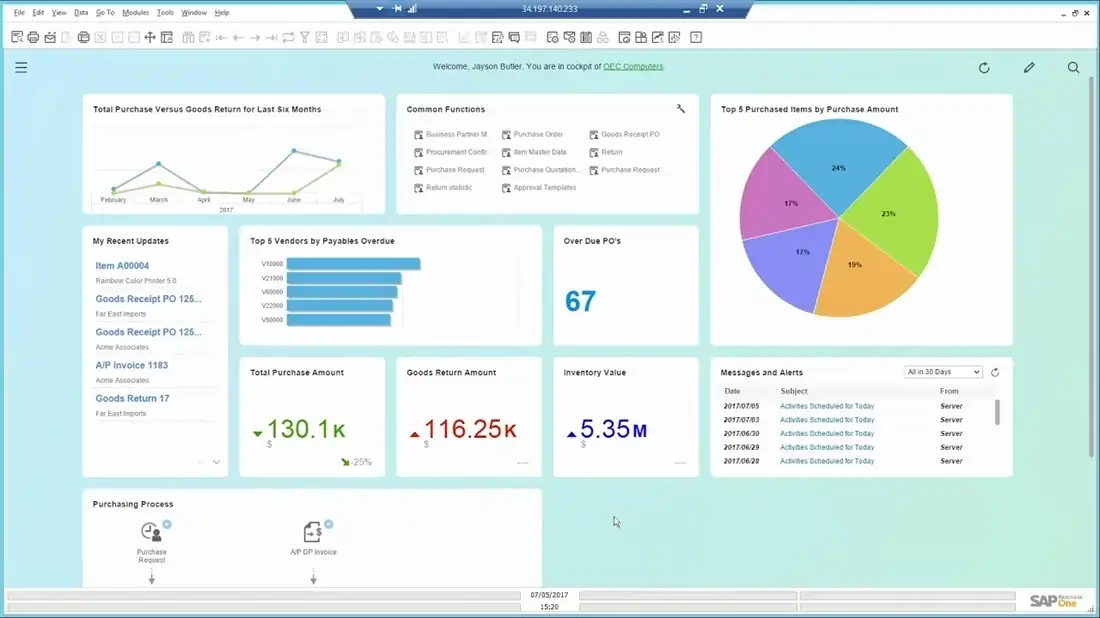
Watch a Demo on procurement and supply chain capabilities in SAP Business One ERP
Every small business needs a systematic approach to managing the procurement process, from requesting vendor quotes, to creating purchase requests and paying vendors.
SAP Business One helps manage the complete order-to-pay cycle, including receipts, invoices, returns, and payments. Integrated reporting tools let you easily compare suppliers and prices to negotiate better deals and identify opportunities for cost savings.
Create purchase requests, POs, and goods receipts; link purchasing documents and view document trails for audit purposes; and manage returns, additional expenses, and multiple currencies.
Manage detailed data in a user-friendly interface, view account balance and purchase analyses, and maintain detailed item purchasing information with price lists and tax information.
Achieve realtime synchronization of goods receipts and inventory warehouse levels;
Invoices, cancellations, and credit memos with a PO reference; plan your material needs; and schedule your purchases accordingly
Generate reports with real-time data and display them in various report formats or dashboards.
Procurement management ensures that the right products or services are obtained at the best possible price, delivered on time, and meet the required quality standards. Challenges businesses face in the manual procurement management process are:
Businesses must understand that by utilising procurement management software, procurement operations can overcome the aforementioned challenges.
Procurement software is a platform that automates and streamlines the procurement process within a business. The software helps businesses to manage the various stages of procurement, from identifying the need for goods or services to final payment and supplier management.
Organizations often have multiple location operations or divisions, each with its own procurement needs and practices. When data is decentralized, it can lead to inefficiencies, lack of visibility, and missed cost-saving opportunities. ERP systems procurement module address this challenge. They centralize procurement management and provide unified platforms where all procurement activities, from requisitions to approvals and vendor management, can be efficiently maintained. For instance, global manufacturing firms often grapple with the challenge of efficiently coordinating procurement activities across their branches. However, after implementing an ERP system, they can establish a centralized procurement hub. This would allow them to consolidate their purchasing power, negotiate better deals with suppliers, and maintain consistent procurement practices across the organization. As a result, they can achieve significant cost savings and improved supplier relationships.
Data plays a pivotal role in decision-making, and ERP procurement systems provide businesses with real-time data and analytics. Thus offering valuable insights into procurement processes. Organizations can make data-driven procurement decisions by having access to up-to-the-minute information on inventory levels, vendor performance, and market trends. Businesses from highly competitive industries like distribution, retail, and manufacturing can gain insights into consumer demand patterns and supplier lead times by harnessing ERP analytics. This data helps them optimize procurement strategy, reducing excess inventory and minimizing stockouts.
Procurement teams often handle time-consuming manual tasks like generating purchase orders, processing invoices, and approving payments. Procurement automation is a game-changer. ERP systems automate routine procurement tasks such as purchase order creation, invoice processing, and payment authorization. This reduces manual errors and frees up procurement teams to focus on strategic activities. Consider a retailer overwhelmed with order processing due to manual procedures. After implementing ERP-driven procurement automation, they can experience a remarkable increase in efficiency. Purchase orders can be generated automatically, invoices are processed without delays, and payments are authorized swiftly. This streamlined procurement approach reduced operational costs and improved customer satisfaction through efficient order fulfillment.
Effective collaboration with suppliers is essential for procurement processes. ERP procurement systems facilitate seamless communication and collaboration with suppliers through portals and real-time updates. By leveraging ERP procurement software, manufacturers can improve communication with their suppliers. This would allow them to share real-time production schedules, quality requirements, and order changes. As a result, lead times are reduced, and the quality of raw materials and components improved, strengthening supplier relationships.
Compliance with regulations and risk management are critical aspects of procurement. ERP procurement systems come equipped with features enforcing regulatory requirements, standardizing procedures, and maintaining comprehensive records. Healthcare providers can maintain stringent compliance standards by using procurement module of ERP. The procurement system autonomously monitors adherence to industry-specific regulations, decreasing the likelihood of legal complications and related penalties. This would not only save the company from potential financial penalties but also enhance its reputation as a reliable and compliant partner in the industry.
ERP procurement systems offer seamless integration with supply chain management, allowing for better visibility and control over the entire supply chain. This integration ensures that procurement processes align with production schedules, preventing stockouts or excess inventory. Integrating ERP and supply chain management would be a boon when businesses face challenges in aligning procurement with production schedules. This integration would allow synchronizing procurement activities with production requirements. As a result, carrying costs can be reduced, and waste in the form of excess inventory would be minimized. This streamlined approach can improve overall supply chain efficiency.
Arguably, the most convincing motive for implementing ERP in procurement lies in its capacity for significant cost reduction via strategic procurement sourcing. Companies can identify cost-effective procurement sourcing strategies by analyzing procurement data and supplier performance. By harnessing ERP-driven strategic procurement sourcing, mega-retailers can conduct in-depth supplier evaluations and renegotiate contracts to obtain better terms. This can result in multi-million-dollar savings annually, demonstrating the immense cost-saving potential of ERP systems in procurement.
SAP Business One is the best selling ERP software system in Kenya and trusted by over 85,000 customers and one million users. The ERP system provides clear visibility into your entire business and complete control over every aspect of your operations.
Explore ERP System OverviewOutgrown your existing system, find out why you should upgrade to an ERP System
Explore ERP System vs Accounting SoftwareYou can manage and maintain supplier related activities with SAP Business One, including issuing purchase orders, updating inventory quantities, calculating the landed cost value of imported items, delivering goods, and handling returns and credits.
When selecting a procurement software in Kenya, businesses should consider the following key factors:
The five R’s in procurement refer to the essential principles for effective purchasing: the right quantity, the right quality, the right price, the right place and the right time. These factors guide procurement professionals in ensuring that goods or services are sourced efficiently. By focusing on these five areas, companies can optimize costs, avoid supply chain disruptions and meet operational needs.
Purchasing is the act of buying goods or services, typically by focusing on the transactional aspects, like placing orders and making payments. Procurement, on the other hand, is a broader process that includes purchasing but also covers sourcing, negotiating contracts, managing suppliers and ensuring compliance. Procurement is strategic, aiming to create long-term value and optimize costs, while purchasing is more tactical and transactional.
In business, procurement refers to the process of acquiring goods, services or works from external sources to meet an organization’s needs. It involves not only purchasing but also sourcing, negotiating contracts, managing suppliers and ensuring compliance. Procurement aims to optimize costs, improve efficiency and build strong supplier relationships. It plays a critical role in maintaining operational continuity and supporting business growth.
Procurement and Supply Chain Software is scalable and can be customized to fit businesses of various sizes and types, from growing to large enterprises, across different industries such as retail, finance, healthcare, and more.
Procurement and Supply Chain Software integrates seamlessly with various third-party applications such as email clients, ERP systems and social media networks.
Procurement and Supply Chain Software employs robust security measures, including data encryption, access controls, regular security updates, and compliance with industry standards for protecting sensitive customer data.
Yes, Procurement and Supply Chain Software is highly customizable to meet the unique requirements of your business, including custom workflows, reports, dashboards, and integration with specific tools and applications.
Procurement and Supply Chain Software can be deployed on-premises or on cloud.
Costs may vary based on the number of users, customization requirements, and the chosen deployment model.
Explore our Kenya specific information based on the challenge you are having.
Read and hear more about the value that customers have seen.
Simply fill out the form and we’ll be in touch.